CCH Medic Ben Wetzel Earns National EMS Fellowship
- Posted On:
- Written By: Caitlin Berkey
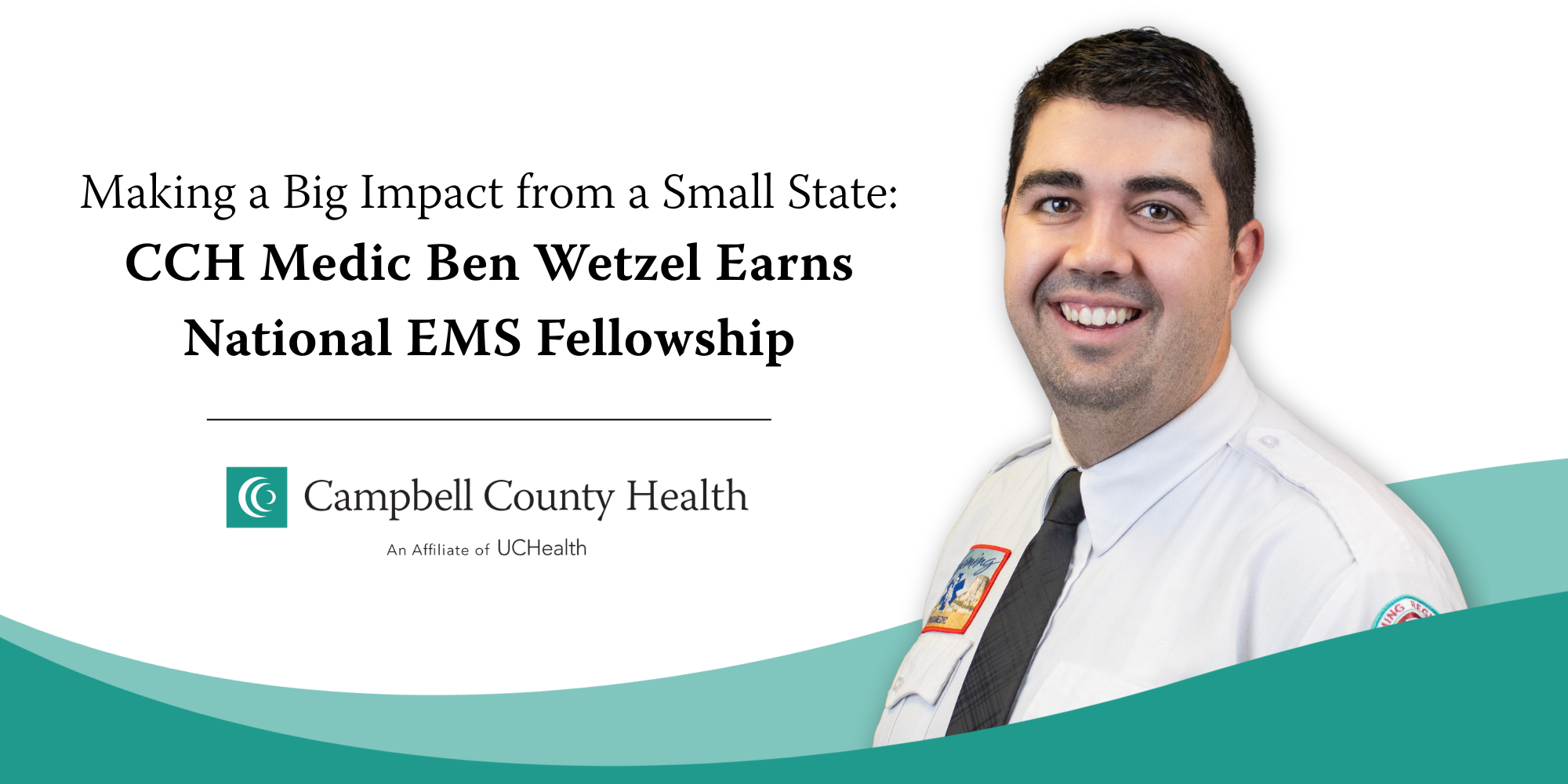
When Campbell County Health Lead Medic Benjamin Wetzel opened his email on October 21, he did not expect to see a career-defining milestone. The message from the National Association of EMS Physicians (NAEMSP) informed him that his application to become a Fellow of the Academy of Emergency Medical Services (FAEMS) had been accepted.
Fewer than 600 professionals hold this distinction nationwide, and only 42 were selected in this year’s class. Wetzel is now one of just four FAEMS fellows in the entire state of Wyoming, with two of those four connected to Campbell County Health.
“Even as the smallest state, we can still have an impact on what the national profile for EMS looks like,” Wetzel said. “In some areas, especially wilderness and austere medicine, we are actually pushing the envelope.”
Wetzel grew up in Powell in a fire-service family, with his dad and cousins employed as firefighters. Because he was too young to join the fire department at 16, he started in volunteer search and rescue and eventually became a volunteer firefighter, a position Ben continues to hold to this day.
When Wetzel was just starting in search and rescue, one of the team members was an emergency room physician. After Wetzel completed a first aid class through the program, that physician invited him to shadow in the ER. Wetzel quickly realized how much he enjoyed medicine and went on to complete an internship on the ambulance during his senior year of high school.
He then enrolled in EMT night classes through the local college while finishing his high school degree. Two days after graduation, he took his national registry exam and started working on the ambulance. When his plans for medical school weren’t in the cards, he accepted a full-time position in EMS. Wetzel has now been in EMS for 10 years.
In 2020, while working full time on an ambulance in his hometown, Wetzel joined CCH EMS as a PRN medic. For two years he worked seven days on in Powell, then seven days in Gillette, gaining experience across the two services.
During that time, he met his wife, Megan, a nurse he worked with at the hospital in Powell. Both were born and raised there but eventually decided they wanted to build their life outside of their hometown. Campbell County Health did not want to lose Wetzel and helped bring both of them on as employees. Megan accepted a job in the CCH Emergency Department, and Ben moved into a full-time role with CCH EMS.
When the opportunity arose to help launch a new Sheridan-based regional EMS service, WREMS, Wetzel became one of the original four lead medics who started the base. Today, Ben continues his work as Lead Medic and EMS leader for CCH.
Wetzel’s fellowship is rooted not only in clinical skill, but also in his work to build structure and standards for EMS across the state of Wyoming.
He serves as vice president of the Wyoming NAEMSP chapter, which was officially recognized in 2020 and now has just over 20 members. Wyoming remains one of the smaller chapters in the country, but it has quickly become visible.
To qualify for FAEMS, Wetzel was required to:
• Be a NAEMSP member for at least three years
• Demonstrate leadership or involvement within the association
• Show documented efforts to advance EMS in Wyoming or the region
• Provide evidence of work in EMS education and mentorship
• Submit multiple letters of recommendation from current fellows and colleagues
His application highlighted several key projects.
Statewide guidelines: Wetzel co-authors CCH’s 367-page patient care guidelines with EMS Medical Directors Dr. Deanna Lassegard and Dr. Isaac Hayward. Those guidelines have been adopted by roughly two dozen EMS agencies across Wyoming, shaping how care is delivered far beyond Campbell County.
Wilderness medicine: He helped develop WREMS’ wilderness medical team and teaches across the region, sharing best practices for environments where hospitals are hours away.
Regional collaboration: Through NAEMSP, he regularly collaborates with wilderness medicine leaders in Kentucky and the Carolinas, which also have significant wilderness areas due to the Appalachian Mountains and extensive park systems. They trade ideas and tools that ultimately benefit patients here at home.
“For a long time, medical direction for EMS was treated like an afterthought,” Wetzel explained. “NAEMSP is about recognizing that EMS medical direction is its own specialty. If you want EMS to function at the level we expect in modern society, you need intentional, well-trained, highly involved medical directors and systems.”
Although the FAEMS designation is academic in nature, Wetzel is quick to point out what it means for patients in Campbell County and across the state.
Emergency medicine has only existed as a formal specialty since the 1970s. For many years it was viewed as a less respected residency option. It was not until the 1990s that EMS fellowships were developed, recognizing a subspecialty of physicians who focus specifically on prehospital care. In the context of medical history, NAEMSP and EMS medical direction are still relatively young, but they are rapidly shaping how EMS is practiced.
The breadth of knowledge required by CCH EMS providers is significant. Dr. Lassegard often notes that she would put our EMS and WREMS staff up against any big-city medic. Urban systems may run large call volumes, but they usually have multiple hospitals within a short distance. By contrast, CCH crews frequently operate in remote areas with limited communication and long transport times.
Wetzel described a recent call for a cardiac arrest at Arrowhead Lodge in the Bighorns, roughly 40 miles up steep switchbacks with no cell service and minimal radio coverage. In those situations, crews must rely on their training and protocols to manage complex cases far from definitive care.
CCH’s medical directors continue to pursue education and professional development, including attending national conferences and advanced courses through NAEMSP. These events offer opportunities to build a broader network and learn how other systems address similar challenges. Wetzel explained that there is always another agency that has already faced a difficult situation and can offer insight on how to handle it.
The Wyoming NAEMSP chapter uses a collaborative app called Basecamp that includes a message board. Members share resources such as checklists and protocols and seek advice on unusual cases. Recently, the CCH EMS team updated its resource card for medication-assisted intubation. The updated checklist was posted to the Basecamp message board so other agencies could adapt it for their own use.
“We do not gatekeep. We share,” Wetzel said. “If we create something that works, we want other EMS agencies to use it. At the end of the day, if it can save someone’s life, that is the goal.”
CCH’s EMS medical directors, including Dr. Deanna Lassegard and Dr. Isaac Hayward, are deeply involved in daily operations. Every cardiac arrest, trauma activation, pediatric patient, and certain high-risk medication uses are personally reviewed. Crews receive detailed feedback and targeted training when opportunities for improvement are identified.
CCH EMS and WREMS also regularly update their guidelines, reviewing the entire document, all 367 pages, three times a year and writing new protocols when new emerging risks are identified, such as rare-earth mining hazards associated with a new facility in Ranchester, Wyoming.
In addition, Wetzel serves on NAEMSP’s national Operational EMS Committee, which focuses on tactical medicine, wildland fire medicine, and special operations. This work allows Wyoming providers to learn from colleagues across the country and to share tools developed here, such as airway checklists and medication-assisted intubation resources.
For all the impressive credentials, Wetzel’s passion for EMS is rooted in quieter moments.
“What keeps me going, and what my favorite part of this job is, is that it is never the same,” he said. “It is about grounding yourself in realistic expectations of what being in EMS means.”
He explains that the calls that truly keep him coming back are the smaller ones. Those are the moments when providers can make a meaningful difference in a patient’s life.
“I do not ever go home from a shift where I did not feel like I helped someone,” he said. “My cup is full.”
“In ten years, I can count on one hand the number of people I would say I truly ‘saved,’” Wetzel added. “That is just not realistic day to day. But I cannot even keep track of the people whose day I made a little better.”
He recalls a recent call for a blind patient who had fallen in his kitchen.
“It was two in the morning,” Wetzel said. “When he fell, he had not realized he had knocked his food tray over and there was rice and meatballs everywhere. We helped him up, but before we left, we swept up his kitchen. That is the stuff that matters. Those small interactions are where you can really have an impact on someone’s life.”
He also credits Campbell County Health with giving EMS providers the space to do what is right.
“There are systems elsewhere where revenue is the first priority,” he said. “We are responsible with our budget here, but at the end of the day the expectation is that we do the right thing for the patient. If I have to call my leaders and say, ‘I knowingly made a decision that will lose money, but it was the right thing for the patient,’ the conversation is basically over. That is rare to find.”
For Wetzel, the FAEMS designation is less about adding letters after his name and more about what it represents: Wyoming’s growing voice in EMS.
“People sometimes see us as the little state that is always trying to catch up,” he said. “But when it comes to things like wilderness medicine, we are at the forefront. Our state hosts international rescue conferences, such as the International Commission on Alpine Rescue, which was recently held in Jackson Hole. Six hundred representatives from around the world came to Wyoming to learn about alpine rescue. We operate in environments many urban agencies never have to face. We deserve a seat at the table, and this fellowship is one small sign that we are earning it.”
As Campbell County Health celebrates Wetzel’s achievement, it is also a moment to recognize the broader team of EMTs, medics, medical directors, and support staff who ensure that when the call comes, whether it is a complicated mountain rescue or a middle-of-the-night fall, patients receive expert, compassionate care.
Their ongoing training, collaboration with state and national partners, and constant review and refinement of patient care guidelines are all proof that CCH staff are working every day to care for patients better than the day before. Wetzel’s FAEMS honor shines a spotlight on that shared commitment and on the big impact a small state can have on EMS, both at home and nationwide.
What is FAEMS?
Fellow of the Academy of Emergency Medical Services (FAEMS) is an honor granted by the National Association of EMS Physicians to members who have demonstrated:
• Long-term commitment to EMS through clinical practice, leadership, or administration
• Significant contributions to advancing EMS, such as guideline development, research, or system design
• Active involvement in education and mentorship of EMS providers or medical directors
• Service to NAEMSP, including leadership roles, committee work, or chapter development
FAEMS fellows may use the post-nominal letters “FAEMS” after their name. The designation recognizes a career of sustained service and leadership in prehospital and out-of-hospital emergency care.
About NAEMSP
The National Association of EMS Physicians (NAEMSP) is a professional organization that promotes:
• Excellence in out-of-hospital emergency care through evidence-based practice
• Education and training for EMS physicians, medical directors, and EMS professionals
• Development of standards and guidelines for EMS medical direction and patient care
• Collaboration and advocacy at local, state, and national levels to advance EMS systems
NAEMSP supports state chapters, including the Wyoming chapter established in 2020, along with national committees that focus on areas such as operations, research, pediatrics, wilderness medicine, and quality improvement. Through conferences, research, and policy work, NAEMSP helps shape how EMS is practiced across the United States and beyond.